
Clay Projected Versus Actual Release
A projected date is an agency calculation based on the sentence information and credits then in the record. It is not proof that a person walked out on that day. IDOC profiles may separately show a Projected Parole Date and a Projected Discharge Date. The first can mark anticipated release from the institution into parole or mandatory supervised release. The second concerns the expected end of the state sentence or supervision obligation. Neither label should be shortened to “released” without checking status and the later record.
Pretrial detention follows a different path. A Clay judge may order release, detention, or changed conditions, but a signed order may precede jail processing or coexist with another hold. A county-sentence completion also may depend on custody credit and a sheriff calculation. Do not apply IDOC's projected-parole framework to someone who never entered IDOC.
Find Clay Projected Release Dates
First identify the custodian. Clay County Jail, IDOC, BOP, and ICE maintain different records. A disappearance from Clay's current IN feed can mean release, transfer, correction, or delay, so it cannot supply a projected date on its own.
- Read the Clay court docket at Judici and match the case, charge, disposition, and sentence.
- If the judgment commits the person to IDOC, open the IDOC offender search.
- Search by IDOC number when known. Otherwise use last name or birth date and compare the profile photograph, physical details, admission facts, and every sentence row.
- Transcribe each label exactly, including status, location, projected parole date, parole date, and projected discharge date.
- For a Clay jail term, ask the Circuit Clerk for the judgment and custody-credit entry, then request the sheriff's calculation or release entry if the exact day is disputed.
- Recheck near the date. Preserve the access date because IDOC may post later credit adjustments.
The captured IDOC search interface illustrates the state search fields and profile route.
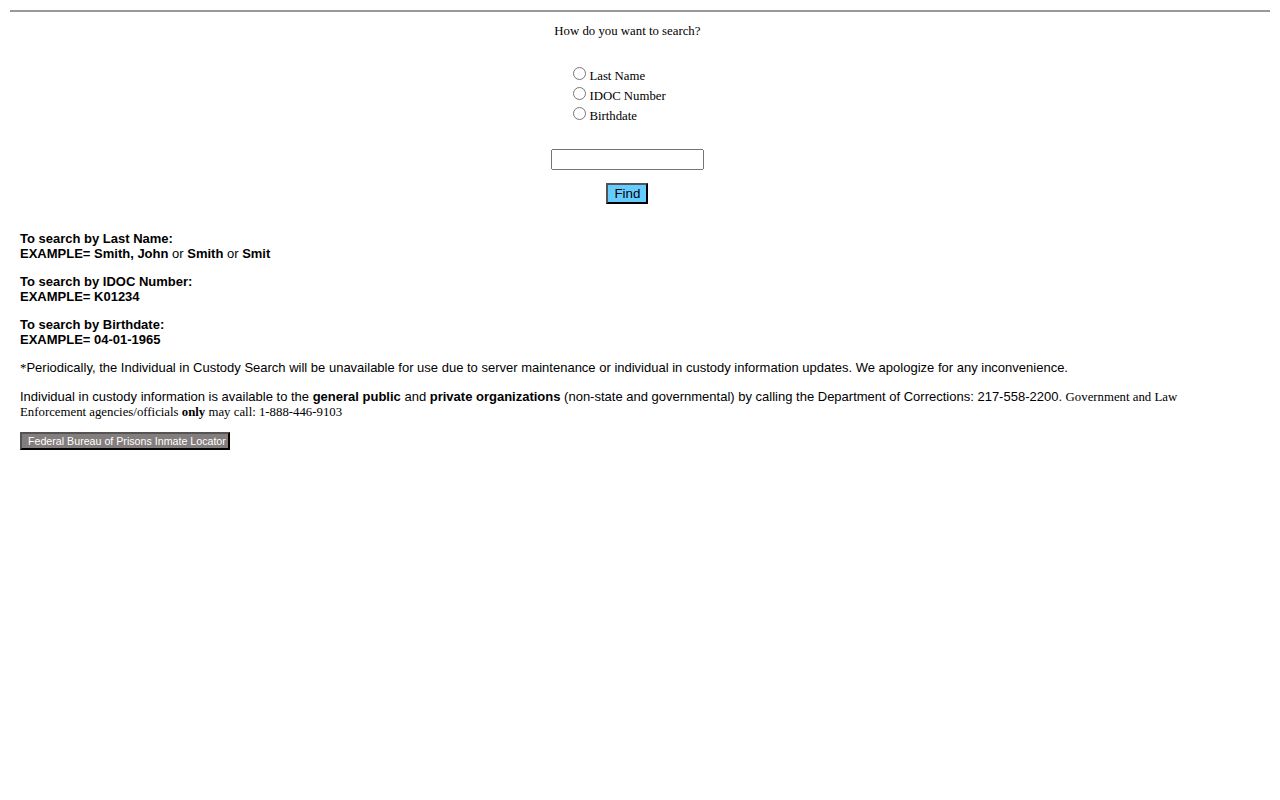
This state tool applies after IDOC admission, not to every Clay County jail booking.
Illinois Credit Changes Clay Dates
IDOC Directive 01.07.400 describes sentence calculations for determinate terms. Directive 01.07.420 describes a method in which the custody date and sentence are adjusted by applicable credits, including awarded earned program credit, with record-office review. Court-awarded presentence custody credit, concurrent or consecutive sentence structure, lost or restored credit, escape or absence time, and later court or PRB action can affect the result.
The controlling law is 730 ILCS 5/3-6-3. Its rules depend on the offense, offense date, and statutory findings. Broad claims that everyone serves half, or that every violent offense uses one percentage, are unsafe.
| Framework | General meaning | Required check |
|---|---|---|
| Ordinary credit | May allow one day of statutory credit for each day served | Confirm statutory exceptions |
| 85% category | No more than 4.5 days of credit per month for listed offenses | Match conviction and offense date |
| 75% category | Specified offenses require greater service | Read the governing subsection |
| 100% category | Specified sentences receive no reduction under that rule | Verify judgment and statute |
No release-date calculator should replace IDOC's calculation. Discretionary program credit cannot be promised for an individual before IDOC awards it.
Why Clay Release Dates Move
A projection changes when its legal or factual inputs change. The public profile should be read as a current snapshot, not a fixed promise.
| Factor | Possible effect | Best record |
|---|---|---|
| Credit award or restoration | May move the projection earlier | IDOC profile and record-office calculation |
| Credit loss | May move it later | IDOC disciplinary and calculation record |
| Corrected judgment | Can alter sentence or custody credit | Signed court order and updated IDOC record |
| Consecutive sentence | Changes how terms combine | Judgment and all sentence rows |
| Detainer or warrant | May prevent community release to the expected place | Holding and receiving agencies |
| PRB action | Can affect parole, revocation, or discharge | PRB order and IDOC status |
A transfer is not community release. If Clay relinquishes custody to IDOC or another agency, obtain the receiving agency name and continue in that official system.
Confirm Clay Actual Release
For an IDOC prisoner, read status, location, parole date, projected discharge, and all sentence rows together. A parole district plus PAROLE supports physical release under supervision. It does not prove final discharge. Request IDOC or PRB records when the public profile is ambiguous.
For a Clay detainee, the sheriff's timestamped release or transfer entry is primary evidence of physical custody ending. The signed court order supplies legal authority. A VINE alert can provide timely notice, but it remains a notification event. Registration must usually occur while the person remains in custody; the Clay VINELink check explains that process.
When two official systems disagree, contact the one responsible for the disputed fact. Ask the sheriff about custody and holds, the court about its order, and IDOC about a state calculation. The full Clay County release record path separates these sources.
Clay IDOC Date Labels
Projected parole and projected discharge answer different questions. The parole projection concerns the institutional portion and expected move into supervision. The discharge projection concerns the expected end of the state obligation. A profile can also show an actual parole date. Record each term as displayed.
One sentence row may say discharged while another stays active. The overall offender status, location, and full sentence table must be reconciled before stating that supervision ended. If the legal conclusion matters, request the final or early discharge order rather than extrapolating from a date that has passed.