
Clay County Three-Day Release Records
No official Clay County 72-hour release view, historical archive, promised update cadence, or online retention period was verified in the official material reviewed as of July 16, 2026. The Clay County Sheriff publishes an inmate-search feature backed by current-custody data. Sampled records were marked IN. They did not include a release date, release reason, destination, or flag for a rolling three-day period.
A useful three-day result must come from an event record. It should identify the booking, exact release time, authority or reason, and any receiving agency. Those details separate community release from transfer. Clay custody may end because a court ordered pretrial release, a charge ended, time was served, a county sentence was complete, or another custodian took charge. Each outcome calls for different proof.
Check Clay County 72-Hour Releases
Begin with the interval, not the live roster. Write the date, time, and time zone at both ends. If checking one person, add the full name, date of birth if known, local inmate or booking number, arrest date, and criminal case number. If checking the log for the whole period, ask for the releasable booking and release entries within that range. A narrow, clear request is easier to process and less likely to return the wrong record.
- Review the sheriff's current inmate search and record only what it shows at the access time. An
INlabel means the feed reports current custody. - Call the sheriff at (618) 665-3316. Ask whether each Clay custody event in the interval was release, transfer, or another event.
- Use the sheriff FOIA form to request the release log, timestamp, reason or authority, and destination when publicly releasable.
- Compare the sheriff record with Illinois VINELink. VINE reports custody events but is not the signed legal order.
- Check the Clay criminal docket and signed orders through the Circuit Clerk's Judici link. The court source explains the legal action.
- If the event was a transfer, use the named receiving agency's official locator. IDOC covers Illinois prison custody, not ordinary Clay County releases.
For a same-day interval, use the Clay County 24-hour release process. The method is similar, but its shorter span is more sensitive to the exact request time.
Clay County Three-Day Record Fields
The public feed's current-custody fields should not be presented as release fields. It can show full name, local inmate ID, physical descriptors, booked and custody-status timestamps, reporting-agency data, charges when supplied, an image reference, and VINE identifiers. The release fields below must be requested from the sheriff.
| Field | Why it matters |
|---|---|
| Full name, birth date, local ID | Reduces mistaken identity. |
| Booking number and booked time | Links the result to one custody episode. |
| Release date and exact time | Places the event inside or outside the 72-hour interval. |
| Release authority or reason | Separates a court release, dismissal, time served, sentence completion, or other event. |
| Destination or receiving agency | Shows whether Clay transferred custody rather than released the person to the community. |
| Case number | Connects the physical event to the court order or disposition. |
Keep the original labels. “Released by Clay,” “PAROLE,” “IN,” and “Projected Discharge Date” describe different facts. A three-day list should not flatten them into one status.
Clay Weekend Release Windows
A 72-hour interval can capture a Friday event when the check is made on Monday. It can also cover several court and jail processing cycles. Yet no official Clay weekend or holiday release procedure, regular release time, exit location, or promised data lag was verified. Those gaps make an exact timestamped request more important, not less.
A court order may appear before the jail completes processing. VINE may send notice after the physical event. The live feed may change without stating why. If sources disagree, match each source to its job: the sheriff controls the physical custody timestamp, the signed court order controls the legal authority, and a receiving agency confirms the next custody. For a known name, the Clay County release search provides the wider agency sequence.
Note: Ask for Friday-through-Monday dates explicitly when that range is intended; do not assume “last 72 hours” uses calendar-day boundaries.
Obtain Clay County Release Logs
Written requests may be delivered or emailed through Clay County's FOIA process. The sheriff form directs requests to Sheriff Andy Myers, P.O. Box 267, Louisville, IL 62858. It asks for contact information, the requested period, record description, incident details, copy preference, and any fee-waiver claim. State clearly that the request seeks booking and release entries for a defined 72-hour interval.
The first 50 black-and-white letter or legal pages are free, and added pages cost 15 cents each. Illinois FOIA generally sets five business days for a response, with a permitted five-business-day extension in specified cases. That response period differs from the three-day event window. A requester seeking urgent personal confirmation should call first, then preserve the written record request.
VINE is useful when registration happened while the person was still in custody. A later alert is corroboration, not the complete legal record. IDOC can show a person transferred into state prison or later released from an Illinois prison. It does not archive routine Clay jail departures.
The court file adds legal context that a log entry may not explain. A dismissal ends the stated charge, but does not prove that no other case or hold existed. A sentencing entry may award enough custody credit for time served, yet processing or another hold can still affect the physical departure time. Ask for the signed order when the legal event is disputed and the sheriff entry when the exact release time is disputed.
Clay Release Feed Data Quirks
Clay's official current-custody data uses the statewide VINE site identifier and the Clay sheriff agency identifier. The reviewed sample was uniformly marked IN. Missing charge arrays and placeholder profile images also appeared. These are characteristics of the sampled interface, not proof that the agency holds no other record.
The official current-custody source is shown in the captured image below.
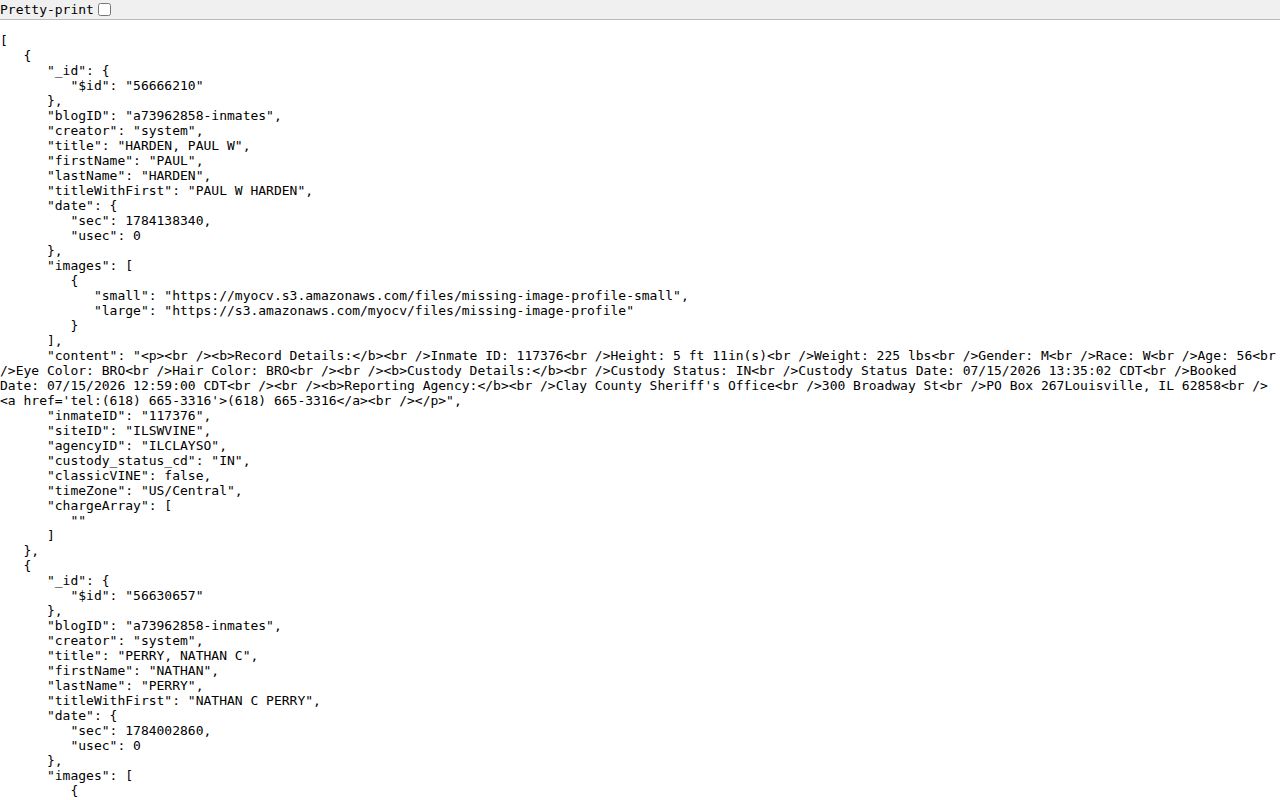
The capture supports a narrow point: Clay exposes current inmate data, not a rolling three-day release archive. Disappearance requires follow-up because it may mean transfer, release, delay, or a changed identifier.
A transfer to IDOC should be checked in the IDOC Individual in Custody Search. A state admission means custody continued. If another county or agency received the person, ask the Clay Sheriff for its name and then use that agency's official system. Never guess a destination from roster absence.
Federal and immigration systems also have limited roles. The BOP locator covers federal prison custody, while the ICE locator covers immigration detention and some recent departures from that system. Neither is a Clay jail release archive. Use one only when the sheriff, court record, or known case path gives a concrete reason to check that custodian. If a system returns no match, record the search terms and access time. A negative search does not prove release.
Preserve the result as a small audit trail. Note who was searched, the identifiers used, the precise interval, each system's label, and the access time. Keep the sheriff response with the related court order. This makes it possible to explain a later data change without rewriting the earlier observation. If VINE reports a custody change while the sheriff calls it a transfer, state both facts and let the sheriff's event type control the description of Clay's physical handoff.
Public Record Search
Sponsored Results